



The Creation/Redemption Process
This is how ETF shares can be created and redeemed.
ETFs allow investors to invest in various markets efficiently and at low cost. ETFs have contributed significantly to the standardization of the investment landscape – not least in terms of the availability of and access to all asset classes and regions. As assets under management in ETFs continue to grow, investors often wonder how new ETF shares are actually created. The creation/redemption process plays a key role in this
In the following article, we explain how the creation/redemption process works, what functions it serves, and how ETF investors are involved in it.
The essentials in brief: Creation/Redemption: Everything You Need to Know
Creation Process: The creation process allows new ETF shares to be created. This enables investors to invest even large amounts in ETFs.
Redemption Process: The redemption process allows existing ETF shares to be returned to the ETF provider.
ETF Specialists: So-called authorized participants (ATs) can create or redeem ETFs in cooperation with the fund company.
Low Spreads: Market makers ensure that ETFs can be traded at any time with low spreads.

Find and compare thousands of ETFs. Use powerful filters, detailed analytics, and independent data to discover the right ETF for your portfolio.
Unlike actively managed funds, ETFs – like stocks – can be traded throughout the entire trading day. They also offer cost advantages – such as lower management fees and lower trading costs. The creation/redemption process is one of the factors responsible for the low costs of ETFs. This process is of fundamental importance to the structure of ETFs.
Definition: What is the Creation/Redemption Process?
The creation/redemption process allows for an increase or decrease in the number of ETF shares based on demand, without affecting other ETF shareholders. This is a key difference from traditional mutual funds, where the purchase or sale of shares affects all investors in the fund.
This process is carried out by specialized entities known as authorized participants (APs). APs are typically large financial institutions, such as banks or investment firms, that interact directly with the ETF provider. ETF investors therefore never make any decisions themselves regarding the creation or redemption of an ETF.
Process: How Are ETF Shares Created?
When demand for a particular ETF rises, new shares can be created (creation) in exchange for underlying securities to meet that demand. Conversely, when demand falls, the number of shares can be reduced (redemption) by exchanging fund shares back for securities.
To replicate the ETF’s underlying index, the market maker, for example, assembles a basket of stocks (which corresponds one-to-one to the underlying index, such as the DAX Index). In return, the market maker receives ETF shares from the fund company equal in value to the basket of securities it has delivered. The process thus involves the exchange of baskets of securities for ETF shares and vice versa. This exchange of a basket of securities for ETF shares is called the creation process (creation = issuance).
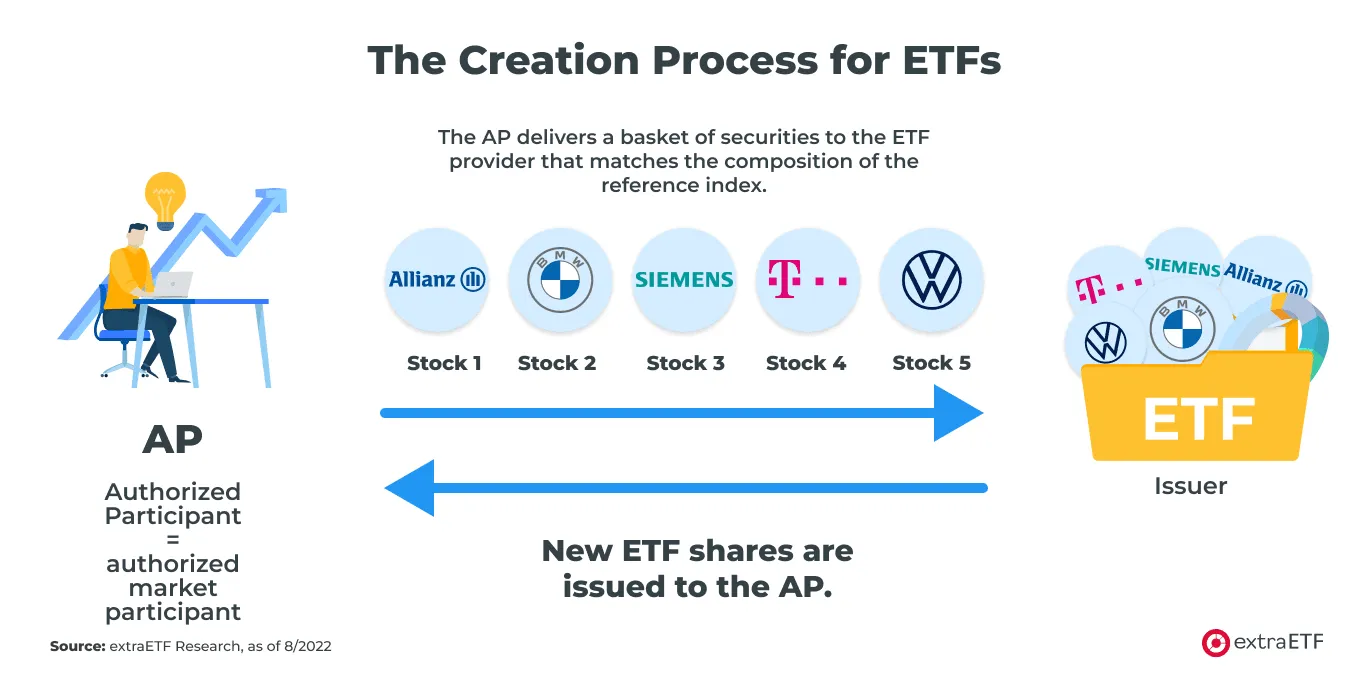
This creation process makes the index tradable, as the market maker can now offer the ETF shares acquired from the fund company for sale on the stock exchange. Alternatively, the market maker may also hold them in its own portfolio.
Conversely, the market maker can also return the ETF shares to the ETF company (redemption) and, in return, receive the corresponding basket of securities back.
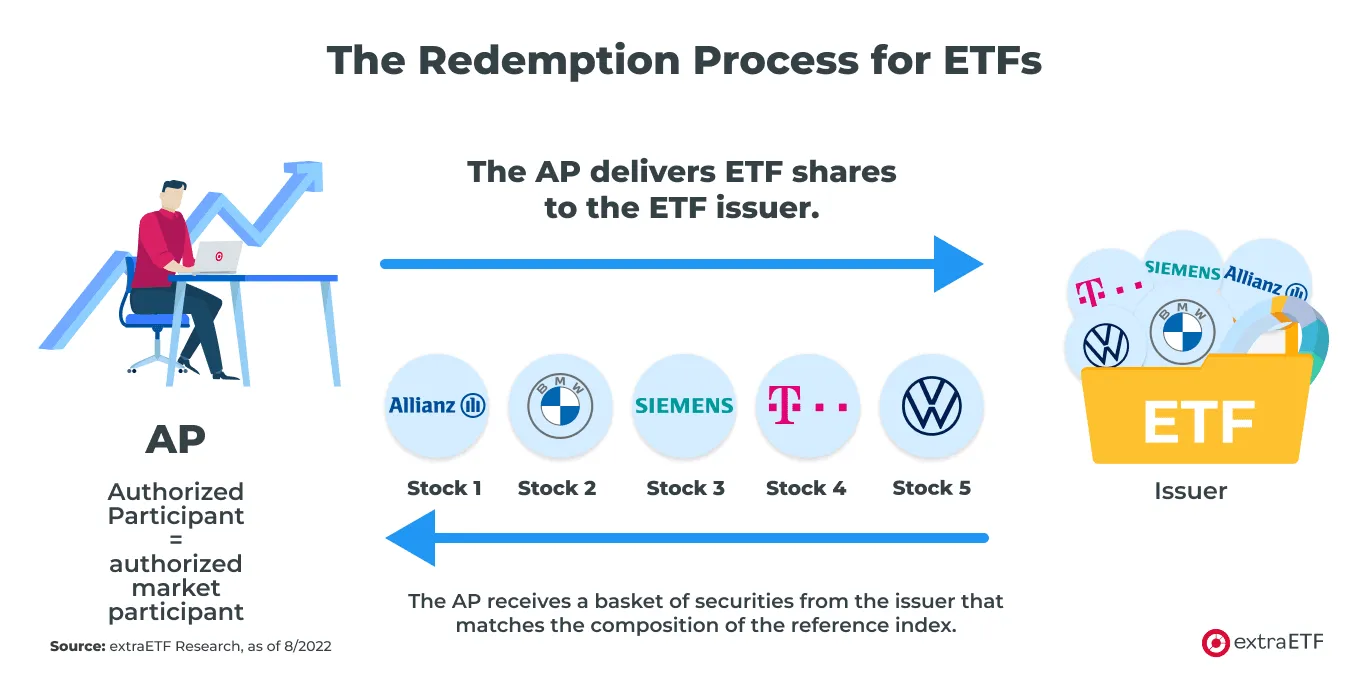
The Life Cycle of a Trading Transaction
To illustrate how this process works, let’s take a closer look at the lifecycle of a trading transaction.
In the following example, an investor wants to purchase 500,000 shares of a newly launched ETF. Since the fund is new to the market, the available volume is minimal. However, the investor knows that the ETF structure offers the opportunity to purchase ETF shares at efficient prices by utilizing the creation/redemption mechanism.
Join the extraETF community
Explore the world of ETFs and make informed investment decisions.
- Find ETFs that match your criteria with our ETF Search.
- Compare costs, performance, and risk side by side.
- Save your favourites to a watchlist and receive price alerts.
- Explore detailed ETF profiles with key metrics and holdings.
Side Note: What is the difference between the primary and secondary markets?
In a nutshell: Anyone who deals with securities in general – and ETFs in particular – often comes across the terms “primary market” and “secondary market.” In primary market trading, securities are created or redeemed directly, whereas in stock market trading – that is, on the secondary market – securities merely change hands: one investor transfers existing securities to another.
Explanation: One of the reasons ETFs are so popular with investors is that they can be bought and sold easily and directly on the stock exchange. The focus is therefore on the secondary market. On the primary market, however, ETFs are first created – a process known as creation/redemption.
All ETF shares traded on the stock exchanges thus originate from such primary market transactions and were subsequently resold by authorized market participants on the secondary market. To ensure efficient trading, it is particularly important that the secondary market be liquid and transparent in order to keep trading costs as low as possible. The primary market, on the other hand, is the financial market where the initial issuance of financial capital takes place.
Step-by-Step: The ETF Creation Process Explained
New ETF shares are created as part of the creation process.
The investor places an order with his broker to buy 500,000 ETF shares.
The broker sells him the ETF shares at a specific price. As mentioned earlier, the process of buying ETF shares is virtually “seamless” for the investor.
Behind the scenes, the broker must create new ETF shares due to the increased demand generated by the trade. The broker is an Authorized Participant (AP) and is now “short” on the ETF shares, since it has sold them to the investor.
The broker now buys the basket of securities held by the ETF as a hedge. This means the broker is “long” on the basket of securities and “short” on the ETF.
The broker then delivers the basket of securities to the ETF issuer, thereby initiating a creation process.
In return, the broker receives new ETF shares from the issuer and closes out its existing short position in the ETF.
It becomes clear that the investor has nothing to do with the creation process itself, but that the mechanism allows the investor to purchase a large number of ETF shares to meet their demand. This process also works in the opposite direction when it comes to redemption.
Step-by-Step: The ETF Redemption Process
As part of the redemption process, existing ETF shares are returned to the fund company.
The investor places an order with his broker to sell 500,000 ETF shares.
The broker buys the ETF shares at an agreed-upon price.
The broker now decides whether a redemption is necessary. The broker is “long” on the ETF because the investor has sold the shares back to the broker.
The broker then sells the basket of securities held by the ETF to hedge its position, thereby becoming “short” on the basket of securities and “long” on the ETF.
The broker then delivers the ETF shares to the ETF issuer, thereby initiating a redemption process.
The broker receives the basket of securities from the issuer and closes out the existing short position related to it.
Even during the redemption phase, the investor was not involved in the process at any time. This was a simple back-office procedure that enables the fluctuation of ETF shares in response to demand.
Did you know? The Role of the Market Maker
Due to the creation/redemption process, large inflows or outflows have no impact on the ETF’s performance relative to the index return.
However, the market maker incurs transaction costs, for example, for buying and selling the stocks included in the index. If the market maker is part of a large bank with its own securities portfolio, it can cover a large portion of the demand from its own trading books and does not have to act as a buyer in the market. This saves on transaction costs, which in turn typically leads to a tighter spread for the ETF.
Another factor influencing an ETF’s spread is the liquidity of the stocks included in the index. The less liquid these stocks are, the greater the transaction risk and the wider the spread. For European blue-chip stocks, the spread is generally much narrower than for a Brazil or China ETF. For ETFs tracking the DAX Index or the Euro Stoxx 50 Index, the spread averages around 0.05 per cent, while for sector ETFs, it can range from 0.2 to 0.5 per cent. For ETFs tracking exotic asset classes, it can even reach one per cent.
Advantages of the Creation/Redemption Process
The creation/redemption mechanism offers numerous advantages that can enhance the efficiency of the ETF structure.
- For example, the flexibility and transparency of ETFs encourage many market makers to support this product.
- These factors ensure that ETFs can be traded as close as possible to the market value or the fund’s net asset value, depending on risks and costs.
- Finally, the creation/redemption mechanism allows the ETF to expand or contract in response to fluctuations in customer demand.
The creation/redemption process thus has a very positive impact on ETF costs, benefiting all market participants.
Conclusion: An important process for maintaining high liquidity
The creation/redemption process plays a central role in ETF trading. It allows new ETF shares to be created or existing ones to be returned to the fund company. This process thus ensures that ETFs are available at all times.
However, the creation/redemption process can only be initiated by authorized participants (APs). These are “appointed” by the ETF providers. Market makers ensure high liquidity and, as a result, favourable spreads (trading costs) for ETFs.
Using our ETF search tool, you can select and analyse all ETFs tradable in Germany. This makes finding the most cost-effective ETF a breeze.
Important Questions About the Creation/Redemption Process
- Creation/Redemption: Everything You Need to Know
- Definition: What is the Creation/Redemption Process?
- Process: How Are ETF Shares Created?
- The Life Cycle of a Trading Transaction
- Side Note: What is the difference between the primary and secondary markets?
- Step-by-Step: The ETF Creation Process Explained
- Step-by-Step: The ETF Redemption Process
- The Role of the Market Maker
- Advantages of the Creation/Redemption Process
- An important process for maintaining high liquidity
- Important Questions About the Creation/Redemption Process
