



Bitcoin Halving: What Is It?
An event that is shaping the crypto market
A Bitcoin halving is more than just a scheduled event on the crypto calendar – it’s a pivotal moment that strengthens the foundation of the Bitcoin economy. Every 210,000 blocks, or roughly every four years, the reward miners receive for adding a new block to the blockchain is halved. This principle, firmly embedded in the Bitcoin protocol, aims to control inflation and gradually reduce the supply of new bitcoins.
The next Bitcoin halving in April 2024 is in the spotlight – not only because of its significance for miners, but also because of its potential impact on the Bitcoin price. But what exactly does this mean?
The essentials in brief: Everything You Need to Know About the Bitcoin Halving at a Glance
Definition: A Bitcoin halving is a periodic event that occurs every 210,000 blocks, or approximately every four years. The block rewards for Bitcoin miners are reduced in order to decrease the supply of new Bitcoins and control inflation.
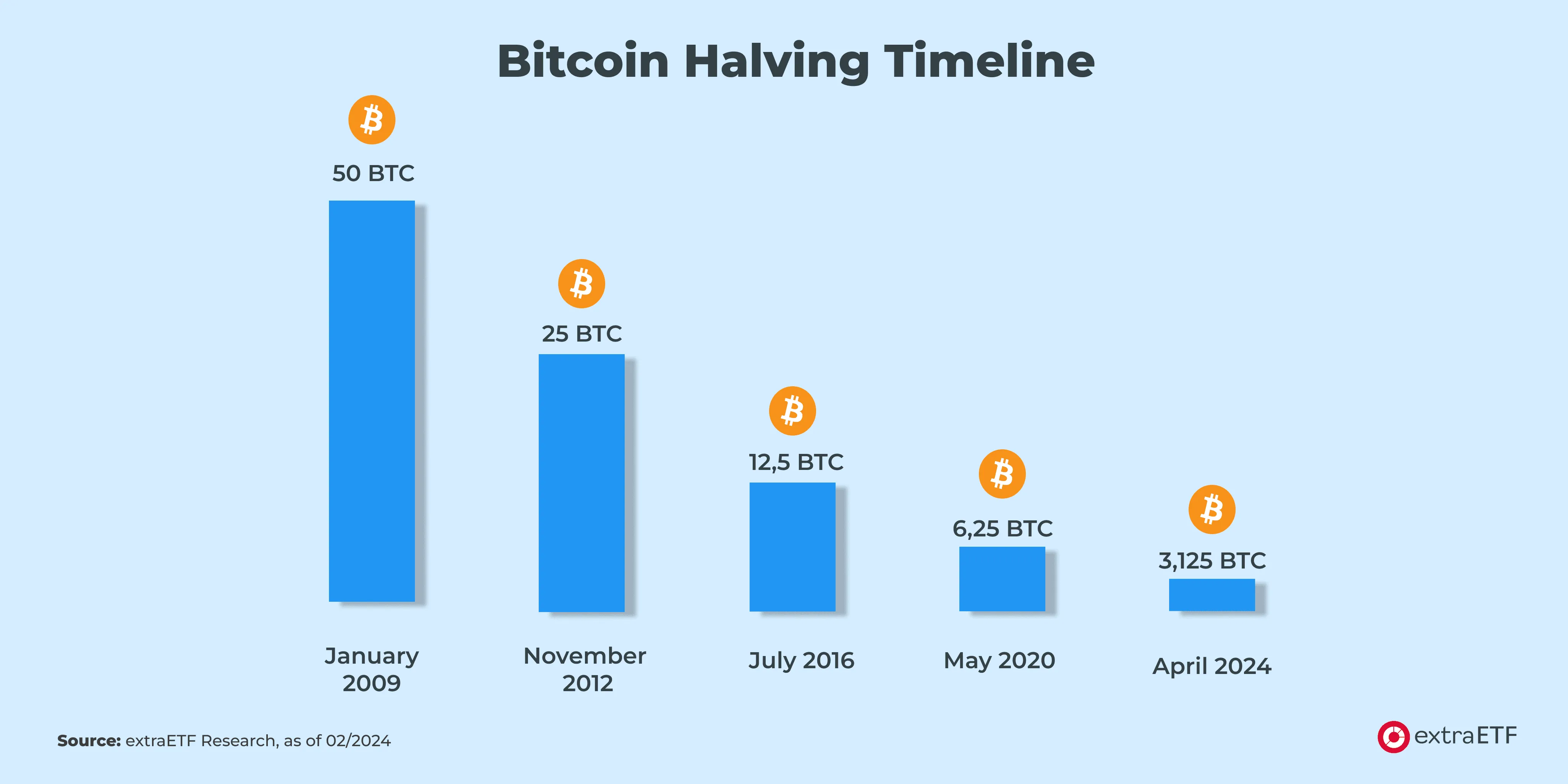
Block Reward: Since Bitcoin’s launch, block rewards have been gradually reduced from the original 50 BTC per block to 6.25 BTC. With the next halving, the rewards will be reduced to 3.125 BTC.
Bitcoin Halving 2024: The next Bitcoin halving is expected to take place on April 23, 2024. This will be the fourth halving since Bitcoin's inception.
Impact on Price: Historically, the halving can influence the price of Bitcoin by reducing the supply of newly generated Bitcoins and potentially increasing demand, although the actual effect on price is determined by many factors.

Find and compare thousands of ETFs. Use powerful filters, detailed analytics, and independent data to discover the right ETF for your portfolio.
Definition: What is a Bitcoin halving?
The Bitcoin halving cuts in half the reward that miners receive for adding a new block to the blockchain. This event occurs approximately every 210,000 blocks, which is roughly every four years.
The goal is to reduce inflation and increase Bitcoin’s scarcity by slowing the rate at which new Bitcoins are created. There have already been several halvings to date, and each time they have led to speculative movements in the price of Bitcoin. With the next Bitcoin halving scheduled for 2024, a significant event is coming into focus for investors and enthusiasts.
The crypto community is eagerly looking forward to April 23, 2024, the day of the next Bitcoin halving. On that day, the block reward will be halved from 6.25 BTC to 3.125 BTC.
Difference: How is Bitcoin halving related to Bitcoin mining?
The Bitcoin halving and Bitcoin mining are closely linked, as the halving directly affects the mining process and the associated economics. Mining is the process by which new Bitcoin transactions are verified and added to the Bitcoin blockchain. The Bitcoin halving, on the other hand, is a recurring event that occurs every 210,000 blocks, which corresponds to approximately every four years. With each halving, the amount of new bitcoins issued as a reward for mining a block is halved. This reduction effectively cuts in half the revenue miners receive for adding a new block to the blockchain.
Simply put, mining is the process necessary for the Bitcoin network to function and remain secure, while the halving is a preprogrammed event that affects the profitability of mining and contributes to Bitcoin’s deflationary nature.
Join the extraETF community
Explore the world of ETFs and make informed investment decisions.
- Find ETFs that match your criteria with our ETF Search.
- Compare costs, performance, and risk side by side.
- Save your favourites to a watchlist and receive price alerts.
- Explore detailed ETF profiles with key metrics and holdings.
Risk Disclosure: The information and statements contained in this article have been prepared to the best of our knowledge and belief. No warranty is given as to their accuracy or completeness. The content is not a substitute for tax and/or legal advice. The content does not constitute such advice and cannot serve as a substitute for it. Therefore, any liability or claims of any kind are excluded.
How many Bitcoin halvings have there been so far?
There have been three Bitcoin halvings so far:
- The first took place in November 2012, when the block reward was reduced from 50 to 25 bitcoins per block
- The second halving occurred in July 2016, when the block reward was reduced again to 12.5
- The third halving occurred in May 2020, when the block rewards were reduced from 12.5 to 6.25 bitcoins per block
Step-by-step: How does a Bitcoin halving work?
The halving event automatically reduces the rewards for mining Bitcoin once a certain number of blocks has been reached. Originally set at 50 BTC per block, this reward is reduced by the halving to decrease the supply of new coins and control inflation. The entire Bitcoin halving process is defined in Bitcoin’s protocol rules and occurs without any manual intervention or decisions by developers or users.
Here's how the Bitcoin halving process works from a technical standpoint:
- Block mining: Miners use specialized hardware to solve complex problems that arise during the mining process. The first miner to solve such a problem is authorized to add a new block to the blockchain. For this contribution to the network, miners receive a reward in the form of newly created bitcoins as well as the block’s transaction fees.
- Reaching the halving threshold: The Bitcoin network is programmed so that a halving event occurs every 210,000 mined blocks. This number is hard-coded into the Bitcoin code and is based on the assumption that a new block is mined every 10 minutes. As a result, a halving occurs approximately every four years.
- Automatic Adjustment of the Reward: As soon as the network reaches the 210,000th block, the reward for mining a new block is automatically halved. This adjustment occurs automatically and applies to all subsequent blocks until the next halving occurs after another 210,000 blocks.
- Reduction of the Block Reward: Before the first halving in 2012, the block reward was 50 BTC. After the first halving, it was reduced to 25 BTC; after the second halving, to 12.5 BTC; and after the third halving in May 2020, it was lowered to 6.25 BTC. The next halving will reduce the reward to 3.125 BTC per block.
- Continuation of the Cycle: This cycle of halvings will continue until the maximum Bitcoin supply of 21 million BTC is reached. This is expected to occur in the year 2140. After that, no new Bitcoins will be created through mining, and miners will be compensated exclusively through transaction fees.
Impact on the market: Why is the Bitcoin halving important?
The Bitcoin halving plays a crucial role in the Bitcoin economy, as it directly affects the number of newly created bitcoins that are put into circulation. By halving the mining reward, the supply of new Bitcoins is reduced, which – if demand remains constant or increases – can potentially lead to a rise in price. Furthermore, the halving underscores Bitcoin’s deflationary nature, which distinguishes it from traditional, inflationary currencies.
Have past halvings affected the price?
Historical data shows that halvings are often accompanied by significant price movements, which can be attributed to the reduced rate at which new coins enter circulation.
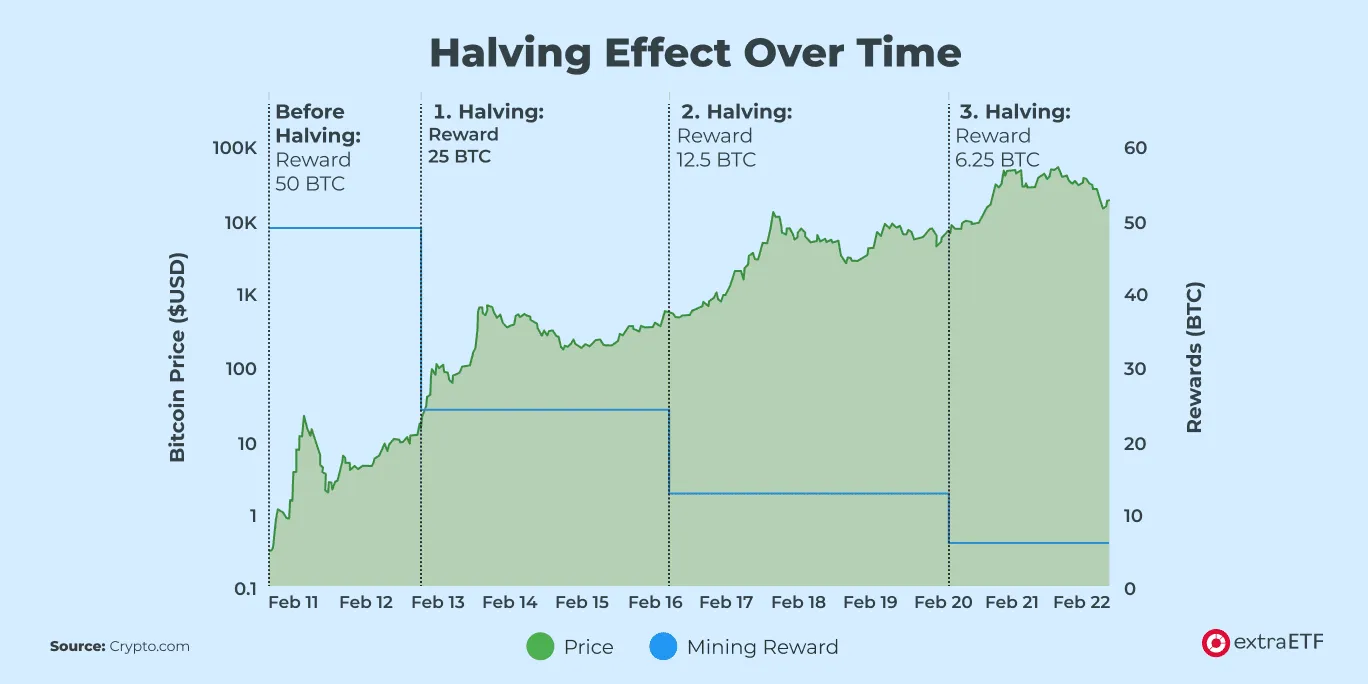
The BTC price trend can be influenced by the halving because:
- The rewards are halved, which promotes healthy and sustainable growth of the network. By reducing the rate at which new bitcoins are generated, the halving ensures that the supply of Bitcoin remains limited and finite, which can preserve its value in the long term.
- Bitcoin’s inflation rate decreases after a halving, meaning that the supply of new coins entering the market is reduced.

How will the 2024 Bitcoin halving affect the price?
What does the Bitcoin white paper say about the halving?
Bitcoin halving is not directly mentioned in the white paper; the term “halving” does not appear at all. However, the paper discusses the limited supply of Bitcoin and the mechanisms for controlling the creation of new coins.
The white paper states that the maximum number of Bitcoins to be created is 21 million and that the rate at which new coins are created or mined is halved approximately every four years. This is the mechanism underlying the halving process. In Section 6, the white paper states the following:
“The steady addition of a constant amount of new coins is analogous to gold miners expending resources to add gold to circulation. In our case, it is CPU time and electricity that are expended.”
Section 4 also states:
"Proof-of-work also solves the problem of determining representation in majority decision-making.
If the majority were based on one-IP-address-one-vote, it could be subverted by anyone able to allocate many IP addresses. Proof-of-work is essentially one-CPU-one-vote. The majority decision is represented by the longest chain, which has the greatest proof-of-work effort invested in it.”
What exactly does the Bitcoin halving mean for investors?
For investors, the next Bitcoin halving is an event of potentially great significance. It offers a unique opportunity to observe the long-term effects of reduced Bitcoin inflation on the price.
Experienced investors closely monitor such events to make strategic decisions. However, it is important to be aware of the risks, as crypto markets can be extremely volatile.
Conclusion: What impact will the Bitcoin halving have?
As the 2024 Bitcoin halving approaches, the question of how this event will impact Bitcoin’s price and the broader crypto market remains a hotly debated topic. Although the halving is seen as a potential catalyst for price movements, investors should employ a well-thought-out strategy and conduct thorough research before making any decisions. As with all cryptocurrency investments, it’s important to be cautious and invest only what you can afford to lose.
Investors should definitely familiarize themselves with the volatility of cryptocurrencies and recognise the importance of regularly adjusting their portfolios (rebalancing) to maximise the potential of these additional investments. In addition, it is beneficial to pursue an investment strategy that extends beyond a single cryptocurrency and also includes other promising digital currencies to increase portfolio diversification. In this context, crypto ETCs can be an attractive alternative, as they offer the opportunity to invest in the performance of multiple cryptocurrencies simultaneously.
More Questions About the Bitcoin Halving
- Everything You Need to Know About the Bitcoin Halving at a Glance
- Definition: What is a Bitcoin halving?
- Difference: How is Bitcoin halving related to Bitcoin mining?
- How many Bitcoin halvings have there been so far?
- Step-by-step: How does a Bitcoin halving work?
- Impact on the market: Why is the Bitcoin halving important?
- Have past halvings affected the price?
- What does the Bitcoin white paper say about the halving?
- What exactly does the Bitcoin halving mean for investors?
- What impact will the Bitcoin halving have?
- More Questions About the Bitcoin Halving
