
Active vs. Passive ETFs
What exactly are the differences?

Exchange-traded funds (ETFs) are a popular choice for investors looking for a simple and cost-effective way to participate in the financial markets. While ETFs are often equated with passive investing, there are now also numerous active ETFs that make it possible to outperform the market.
In this article, we’ll highlight the differences between passive and active ETFs to help you find the best investment strategy for your needs.

The essentials in brief: Active vs. Passive ETFs: Differences at a Glance
Cost Efficiency: Passive ETFs have lower management fees because they do not require active fund management.
Flexibility: Active ETFs leverage the expertise of fund managers to incorporate positive or negative views on companies into their investment decisions and respond flexibly to market changes.
Return Potential: Active ETFs aim to generate higher returns through the targeted selection of securities. Passive ETFs are designed to track an index.
Examples: One example of an actively managed ETF is the JPMorgan Global Research Enhanced Index Equity (ESG) UCITS ETF, which is actively managed to capitalize on opportunities in global equities. The Vanguard S&P 500 ETF, on the other hand, passively tracks the performance of the S&P 500 Index by purchasing all the stocks included in the index.

Find and compare thousands of ETFs. Use powerful filters, detailed analytics, and independent data to discover the right ETF for your portfolio.
What is the difference between active and passive ETFs?
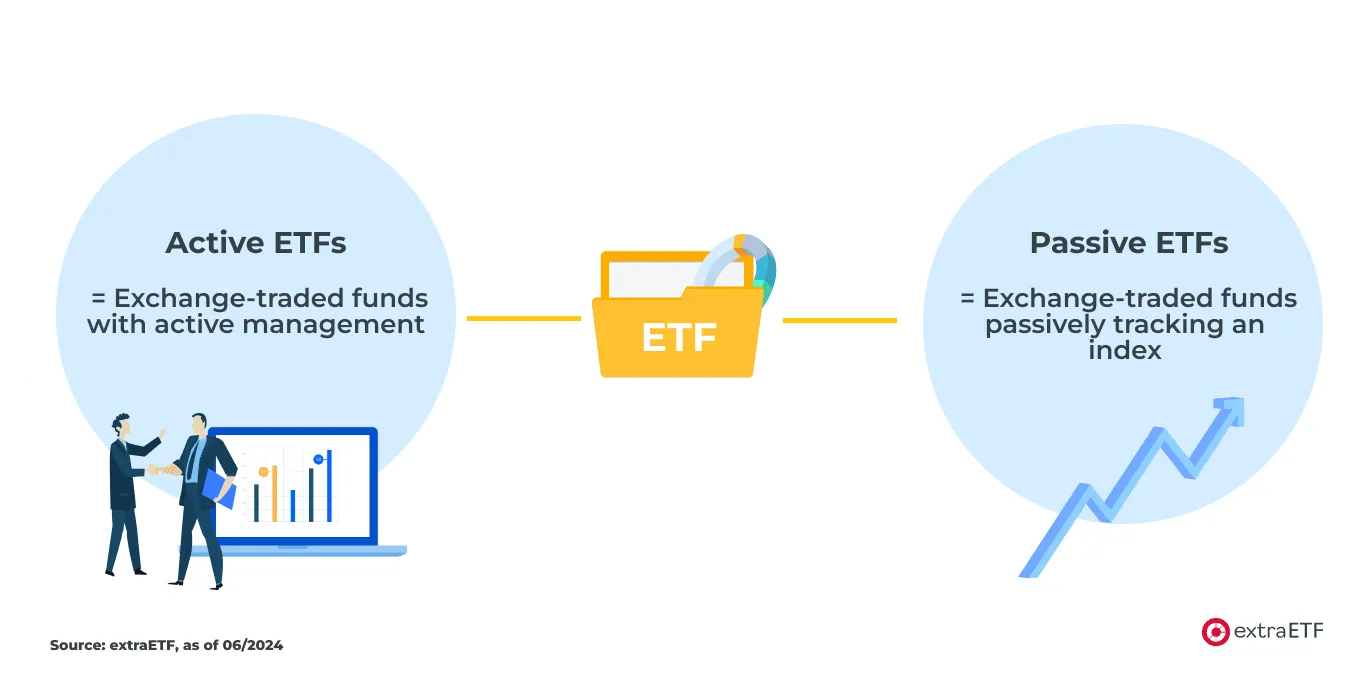
The main difference between active and passive ETFs lies in their investment strategy and management. Active ETFs are actively managed by fund managers who seek to outperform the market through the targeted selection of securities. These ETFs leverage the expertise of the management team and insights from fundamental company research to apply this knowledge advantage to stock selection and respond to market trends and opportunities. This comes with slightly higher fees for management services.
Passive ETFs, on the other hand, aim to replicate the performance of a specific index as closely as possible. This index replication is achieved by purchasing all or a representative selection of the securities included in the index. They are often more cost-efficient, as they do not require active management and simply hold the securities included in the index.
Summary of the Differences Between Active and Passive ETFs
| Features | Active ETFs | Passive ETFs |
|---|---|---|
| Objective |
|
|
| Tradability & Access |
|
|
| Fee Structure |
|
|
| Performance potential |
|
|
| Target audience |
|
|
| Risk Management |
|
|
Join the extraETF community

Explore the world of ETFs and make informed investment decisions.
- Find ETFs that match your criteria with our ETF Search.
- Compare costs, performance, and risk side by side.
- Save your favourites to a watchlist and receive price alerts.
- Explore detailed ETF profiles with key metrics and holdings.

Many Similarities Between Passive and Active ETFs
 Ivan Durdevic, Head of ETF Distribution for Germany, Austria, and Switzerland
Cost Comparison
The differences in the cost structure between active and passive ETFs can have a significant impact on investment returns over the long term. Active ETFs incur slightly higher fees due to their management expenses, while passive ETFs are more cost-effective because of their index-tracking strategy.
Active ETFs have higher fees because they must cover the costs of portfolio management and analysis by professional fund managers. In recent years, however, the costs of active ETFs have fallen significantly.
Are there differences in returns between active and passive ETFs?
Historically, passive ETFs have demonstrated stable performance that correlates closely with the performance of their underlying index. Active ETFs have the potential to generate higher returns, but this depends heavily on the fund management team’s expertise in implementing successful investment strategies.
This makes it all the more important, when investing in active ETFs, to choose a provider that has demonstrated – through proven strategies and a long track record of outperformance – that it can actually deliver this added value.

Conclusion: Active or passive: Which ETF is right for me?
Both types of ETFs – active and passive – offer unique advantages that can demonstrate different strengths depending on investors’ investment goals and strategies. The two types also complement each other well and can be included together in a portfolio.
Passive ETFs are ideal for investors seeking a cost-effective, long-term, and broadly diversified investment. They allow investors to participate in general market trends at a low cost. Active ETFs, on the other hand, offer the opportunity to potentially achieve higher returns through active management and targeted security selection, to manage risk, and to focus on specific areas – such as sustainability – while still investing closely tracking an index.
Active management is particularly beneficial during volatile market phases, when there are significant valuation discrepancies – as is currently the case – or, for example, in inefficient markets where less research is available. Thus, it makes sense to diversify an existing passive portfolio with active ETFs, to reactivate specific sectors, or to add another dimension to the allocation using innovative strategies.
Ultimately, the choice between active and passive ETFs should be based on a careful assessment of one’s own investment goals, risk tolerance, and market views.